” We like to yap about how we lead the nation by example,” he said. “Unfortunately, in this case, California led the racist anti-Japanese American motion.”
President Franklin D. Roosevelt’s executive order No. 9066 establishing the camps was signed on Feb. 19, 1942, and 2/19 now is marked by Japanese Americans as a Day of Remembrance.
California legislators are anticipated to approve a resolution Thursday providing an official apology for the state’s function in the internment of 120,000 Japanese Americans during World War II. Democratic Assemblyman Al Muratsuchi, who was born in Japan and is one the approximately 430,000 individuals of Japanese descent living in California, introduced the resolution.
” We like to talk a lot about how we lead the nation by example,” he said. Thursday’s resolution does not come with any compensation. He said anti-Japanese belief started in California as early as 1913, when the state passed the California Alien Land Law, targeting Japanese farmers who were perceived by some in California’s enormous farming market as a risk. Japanese internment camp at Manzanar, Calif. (AP) Two camps were located in the state– Manzanar on the eastern side of the Sierra Nevada in main California and Tule Lake near the ” I desire the California Legislature to officially apologize and acknowledge while these camp survivors are still alive,” Muratsuchi stated. He stated anti-Japanese sentiment began in California as early as 1913, when the state passed the California Alien Land Law, targeting Japanese farmers who were perceived by some in California’s massive agricultural industry as a hazard. 7 years later the state barred anybody with Japanese origins from buying farmland.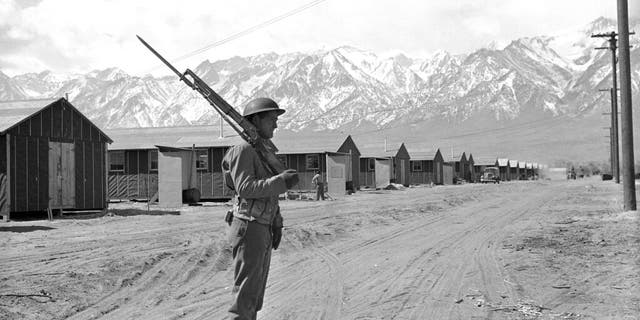 In this May 23,
1943, file picture, an American soldier guards a
The resolution, co-introduced by California Assembly Republican Leader Marie Waldron of Escondido, makes a passing recommendation to “recent national occasions” and says they act as a pointer “to gain from the mistakes of the past.”
Muratsuchi stated the inspiration for that passage were migrant children kept in U.S. federal government custody over the previous year.
CLICK HERE TO GET THE FOX NEWS APP
Les Ouchida, who was 5 years of ages when he and his family were drawn from their house in 1942, said Japanese families like his always considered themselves devoted citizens prior to and after the internments. He holds no bitterness towards the U.S. or California federal governments, picking to concentrate on positives outgrowths like the irreversible exhibit at the California Museum that supplies an unvarnished view of the internments.
” Even if it took time, we have the goodness to still apologize,” he stated.
The Associated Press contributed to this report.
A congressional commission in 1983 concluded that the detentions were a result of “racial prejudice, war hysteria and failure of political leadership.” Five years later, the U.S. government officially apologized and paid $20,000 in reparations to each victim.
Thursday’s resolution doesn’t featured any compensation. It targets California’s role in assisting the U.S. federal government’s policy and condemns actions that assisted fan anti-Japanese discrimination.
from WordPress https://ift.tt/2uSPPH1

Keine Kommentare:
Kommentar veröffentlichen